Evacuees subject to racist and other prejudices
Industrialization was taking its first steps in Finland in the 1940s, and as it grew, construction in cities only intensified in the 1950s. In addition to poor living conditions, harmony of the society was affected by other forms of social deprivation. Social policy reforms were initially accelerated by cooperation between the three largest parties in a coalition government⁴, but the failure of cooperation in 1948 weakened the Left-wing parties, leaving the Central Agrarian Union as the ruling party.
The forced rapid decision-making and joint effort to resettle the displaced Karelians, especially during the early wars, concealed the seeds of diversity and disagreement brought to light by new research and publications. They tell, for example, more about Karelians living in rural areas through publications, than about those living in cities. There was a lot of unemployment among the settlers in the urban settlement sites, and Karelians had to live on temporary jobs, on their own resources, or on state care. Other Finns often blamed the evacuees for being the cause of many social problems that arose after the war.
After the start of the Winter War, the sudden appearance of the evacuees on the road ignited an old prejudice against wandering people, especially outside large population centres. Questions “Why did you start to wander in the first place?” or a general statement, “No one forced you to leave” worsened the distress of evacuees. “I wonder where the market is as the gypsies move in such big crowds?” asked people in Lappeenranta when the first evacuation trains came to the city on their transit journey. Comparison to ‘wanderers’ and discriminated Roma people were expressions of rejection that also sought to show newcomers their lower position in the social hierarchy.
Nothing caused tighter and longer-lasting tensions in the settlement of the migrant population than a misconception that the Swedish-speaking population would have been spared from the statutory obligations of land transfer and settlement. Small farms of less than 20 hectares were exempted from the land division, as a result of which little evacuees were hardly inhabited in Swedish-speaking Ostrobothnia. In the information climate marked by censorship, rumours often took the place of the news, and they, among other things, branded the people of Ostrobothnia as frugal and also reluctant to sacrifice their lives to the extent that the Eastern Finns did. The idea was that the settlement of the Karelians should not substantially change the language relations of the municipalities. The Language Section was registered in the law with the background support of Prime Minister Juho Paasikivi. However, the law did not affect the settlement of evacuees a great deal, and 13,000 evacuees were settled in Swedish-speaking areas.⁵ The language dispute is an example of the long-lasting tensions in Finnish society that have erupted in various historical crisis situations.
The practical supervisors of the resettlement of evacuees were the local maintenance managers who enjoyed state pay. Evacuations and relocations were management of chaos, especially after the Winter War, and an important task was to prevent the influx of people into cities. In May 1940, for example, Kirkkonummi’s maintenance manager was given two days to acquire living space for 150 Karelians, even though the apartments were still full of wartime evacuated Helsinki residents. The evacuees were typically first gathered at primary schools and youth club houses. When many people moved to the locality at once, negative and slanderous stories began to spread rapidly. Most often, they concerned willingness to work versus living on the cost of others.
Cultural differences included e.g. different conceptions of time, which people related with working ethics. The Karelians did not work according to the clock but according to the actual conceived need for work, instead. In Western Finland the work culture followed the pace of the clock that indicated hours of work and hours of rest more rigorously. In the locals’ eyes, the Karelians who had already completed their work in one long shift, were lazy.
Some of the evacuees were trained in middle-class occupations and were unskilled as farm hands. Those who did accept temporary jobs willingly, were new competitors in the local labour market and received demeaning speech by envious locals. The Karelian food tradition also differed from that of Western Finland. In Karelia, rye bread and Karelian pasties were baked at least once a week, while in Western Finland, flat rye breads were made twice a year. The loaves were dried on skewers and eaten by dipping them in food. The smoke rising from the chimney of the baking Karelians made the surrounding villagers consider them extravagant.
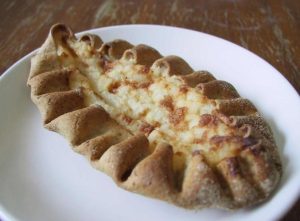 Karelian pasty (karjalanpiirakka) is a traditional Finnish dish made from a thin rye crust with a filling of rice. Butter, often mixed with boiled egg (eggbutter), is spread over the hot pasties before eating. (Wikipedia – Public domain) Photo taken by Jarno Elonen
In Raisa Lardot’s first residence in Ostrobothnia, her family was housed in a clubhouse, where they were placed on a stage to live in. In her later residence in Mellilä, it was very difficult for her to accept her differences with the local children and dare to go to elementary school. Fortunately, there was an enlightened teacher who guarded compassion for the Veps immigrant in class:
“The teacher had explained to the other children that I was from the Veps People and that I had had difficult times. He asked that everyone try to be really kind to me, because once I had hard times.” … “Fortunately, I found this teacher, who was not just anyone, but a civilised man who knew more than the others, these locals.”
Postdoctoral researcher Heli Kananen has re-read the Karelian memory data and found descriptions of the living conditions and attitudes towards the evacuees of the minorities who had previously been silent in academic studies. Contemporary writers hid the social reality of the time of return to peace and the contradictions that emerged between the Greek Orthodox migrants interviewed and the local population that received them in the 1940s. Both the narrators and the researchers wanted to maintain the Finnish survivor identity. The migrants themselves fell silent because they were ashamed of the discrimination they had felt from the local population. One of the reasons was also that differences between religious customs arose, and religion used to be a topic not discussed.
The brave author Lardot, who dared to describe her negative memories as early as the 1970s, says in the afterword of a reprint of her book Ripaskalinnut:
“This book is about a war invalid. For I think not only those who are wounded in the trenches are wounded in the war. A small child, a civilian, is also injured.” … … “Today, refugees are well taken care of here in Finland, educated, dressed, fed, helped to get started. It’s good. I am proud of my mother. Thanks to her, I can say that a Veps person is also hardy, not just a Finn.”
In Lardot’s autobiographical novel, her mother was the most dramatic victim of the family. Unskilled, she could not get milk from the dairy at the right hour or defend her rights to social aid in the municipality. Because of the temperament of the parents, family quarrels were heard far away. On the one hand, the author tells that she was ashamed of her mother’s lavish gestures, on the other hand, how she enjoyed her comedy on the home ‘stage’:
“She started acting like a Finn, not trying to be the way we did. And we couldn’t escape laughing. How could we, when the Finns suddenly, represented through our mother, became whimsical, arrogant and stupid, instead of being admirable and worth imitating as otherwise. Mom just strolled in the middle of the floor, took arrogant expressions and gestures, and at times fell into tragic lament: no money no money, she was moaning. Or put a fist high on her head, and shouted: ‘You bloody Russkies, get out of here fast, as if you were already, fast, fast!’. And we started playing, too.”
Recent research shows that remaining silent about the emotional injuries caused by the war may lead to the transfer of emotional burdens to future generations. The work of grieving ought to be completed. Whether it will be possible to reach the emotions that the war raised, is a different question, still. The war can be characterised as a key experience that influenced the worldview of those who went through it.
Doctor of Education Eeva Riutamaa has studied emotional memories of evacuees. Four-fifths of her interviewees were well received in the new home region. Riutamaa’s interest in the stories of evacuees arose from her own mother’s sadness, which included a hidden truth about childhood and evacuation experiences. “I had always wondered about my mother’s sadness. At times she was happy, but the other day was quite different. She fell silent and kept her background secret for decades.” Many evacuees felt that they had been heard about the harsh experiences for the first time in connection with Riutamaa’s study. She had been the first one to be interested and to listen. When the hosts or land donors did not want strangers, it had manifested itself as ill-treatment in everyday life.